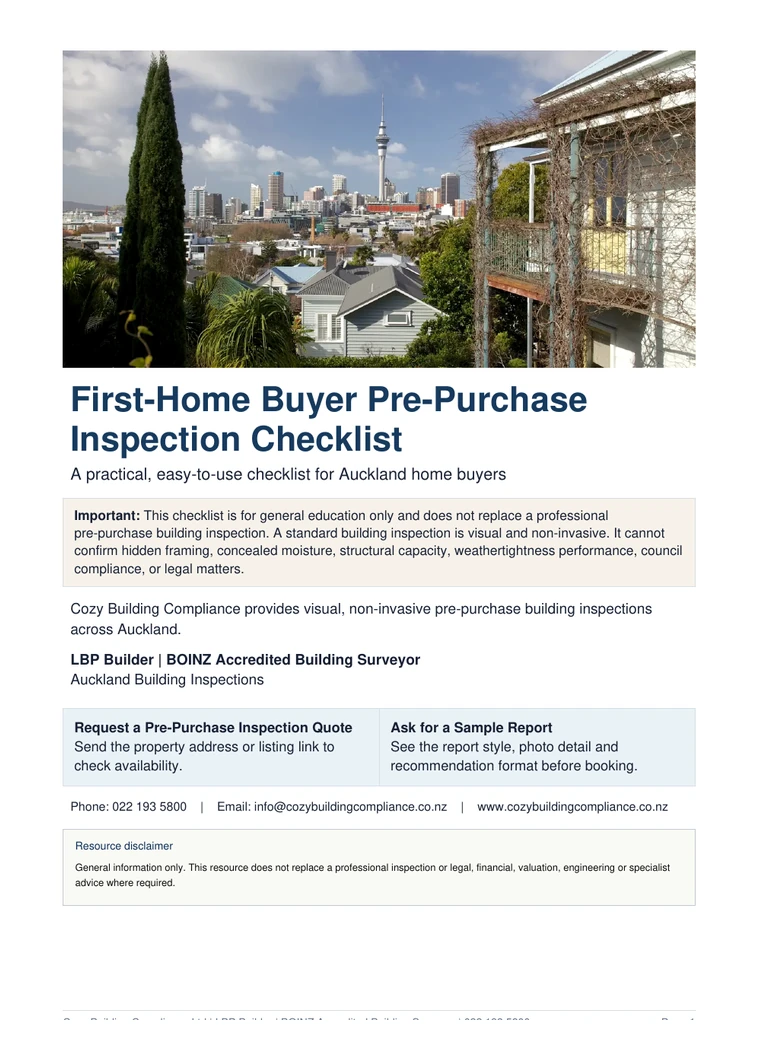
Found a Home? Know What to Check Before You Offer.
A practical Auckland checklist for open homes, property documents, building inspections, going unconditional and understanding a building report.
It is not a complete mortgage, KiwiSaver, legal or financial guide. For mortgages, KiwiSaver, sale methods and the wider home-buying process, use current official New Zealand guidance.
Prepared by Young Tsai — Licensed Building Practitioner in the Carpentry licence class and BOINZ Accredited Building Surveyor.
General education only.
This checklist is not a property inspection, condition assessment, property score or recommendation to buy. Use normal, safe access only and do not enter roofs, roof spaces, subfloors, confined spaces or restricted areas.
How it works
Use the checklist in three practical steps
1Choose your buying stage.
2Review the relevant checklist items.
3Arrange professional follow-up where appropriate.
Interactive property checklist
Choose how you want to start
Use the 12-item quick start for the essentials, or open the complete 42-item checklist. Both modes use the same approved checklist content and share reviewed items during this browser session.
Choose a buying stage to begin
Your reviewed selections stay in this browser session only.
Selected buying stage
Planning an open home
Prepare questions, timing and basic property information.
0 of 5 items reviewed0 of 42 checklist items reviewed
Progress records checklist use only. It is not a property score, inspection result or confirmation that due diligence is complete.
Status
Do not enter private areas or rely on photographs as a substitute for viewing the property.
What this means
Write down the basic property details before you arrive so you can compare what is advertised with what you see and with later council or legal documents.
Why it may matter
Age, construction type and later additions can affect the questions, documents and specialist checks that may be relevant.
What you may record
Address; advertised year or era; cladding and roof type stated in the listing; additions, conversions or recent renovations mentioned.
Limitation
Listing descriptions are marketing information and may be incomplete or inaccurate. This step does not confirm materials, age, consent status or condition.
Specialist advice
Ask the agent for supporting documents and have your lawyer or inspector review relevant information.
Safety warning
Do not enter private areas or rely on photographs as a substitute for viewing the property.
What this means
Request the LIM, record of title, council property file or consent documents, seller disclosures and any seller-supplied building report that is available.
Why it may matter
Early access to documents gives you more time to identify missing information and arrange legal, building or specialist review before a deadline.
What you may record
Documents received; document dates; missing documents; who supplied each document.
Limitation
The availability of a document does not confirm that it is current, complete or suitable for you to rely on.
Specialist advice
Your lawyer should review legal documents. A suitably qualified inspector should review building-related information relevant to the inspection.
What this means
Use calm, specific questions rather than asking only whether the house has any problems. Ask about previous leaks, storm or flood events, insurance claims, major repairs, recladding, drainage work and unfinished projects.
Why it may matter
Past events and repairs may affect the documents, inspection focus, insurance and specialist advice you need.
What you may record
Question asked; answer given; date; person who answered; any promised supporting document.
Limitation
Verbal answers may be incomplete and do not replace written disclosure, council records, a building inspection or legal advice.
Specialist advice
Ask your lawyer how important information should be recorded or addressed in the sale and purchase agreement.
What this means
Keep a separate due-diligence budget rather than using the full amount available only for the purchase price and deposit.
Why it may matter
First-home buyers may need to pay for reports and professional advice even when they do not ultimately buy the property.
What you may record
Estimated legal fee; LIM or council-document cost; inspection budget; contingency for specialist checks or urgent quotes.
Limitation
Actual costs and timeframes vary by property, provider, council and buying method.
Specialist advice
Confirm likely costs and timeframes directly with your lawyer, lender, inspector and any specialist.
What this means
Confirm whether the property is being sold by negotiation, deadline, tender or auction, and identify the last practical time to inspect and review the report.
Why it may matter
Auctions and short due-diligence periods can require reports and legal review before you are committed.
What you may record
Sale method; offer or auction date; finance or due-diligence deadline; agent access contact; preferred inspection date.
Limitation
This checklist cannot determine appropriate contract conditions or whether there is enough time to complete due diligence.
Specialist advice
Ask your lawyer about timing and conditions. Confirm inspector availability before relying on a proposed deadline.
No checklist items match these filters.
You have reviewed all checklist items in this stage.
This records checklist use only. It does not mean the property has passed an inspection or that your due diligence is complete.
0 of 16 items reviewed0 of 42 checklist items reviewed
Progress records checklist use only. It is not a property score, inspection result or confirmation that due diligence is complete.
Status
Stay on normal paths and accessible ground. Do not enter unstable slopes, excavations or flooded areas.
What this means
Walk around the property and observe the general direction of surface water flow, especially beside walls, garages, decks and low points.
Why it may matter
Water repeatedly collecting or flowing toward a building can contribute to dampness, foundation or subfloor concerns and maintenance needs.
What you may record
Low areas; visible channels; recent fill or paving; water marks; locations where the ground is close to cladding.
Limitation
A dry-weather visit cannot show how the site performs during heavy rain, and this check does not assess underground drainage design or capacity.
Specialist advice
A building inspector can assess visible site conditions. A licensed drainlayer, engineer or other specialist may be appropriate where drainage performance is uncertain.
Safety warning
Stay on normal paths and accessible ground. Do not enter unstable slopes, excavations or flooded areas.
Do not lift heavy grates, open manholes or enter drainage structures.
What this means
Notice standing water, silt, debris, overflowing channels, disconnected downpipes or discharge points close to foundations.
Why it may matter
Visible drainage concerns may increase moisture exposure and may require maintenance or further investigation.
What you may record
Photo and location of ponding, blocked grates, downpipe outlets, overflow marks or erosion.
Limitation
A visual check cannot confirm whether underground stormwater or wastewater pipes are blocked, damaged, connected correctly or sized adequately.
Specialist advice
Use a licensed drainlayer for drain testing, tracing or repair advice where concerns are identified.
Safety warning
Do not lift heavy grates, open manholes or enter drainage structures.
Do not climb onto the roof, use ladders or access elevated areas during an open home.
What this means
Stand back and look for obvious rust, broken or displaced tiles, missing sections, patching, uneven roof lines or heavy debris.
Why it may matter
Roof defects can allow water entry and may involve significant maintenance, but many areas cannot be assessed from an open-home viewing.
What you may record
Roof material stated; visible rust or damage; approximate location; areas hidden from view.
Limitation
Ground-level viewing is limited and cannot confirm flashings, fixings, underlay, roof pitch details, concealed leaks or remaining service life.
Specialist advice
Arrange a professional inspection. A roofer may be needed when closer inspection, repair scope or cost advice is required.
Safety warning
Do not climb onto the roof, use ladders or access elevated areas during an open home.
Do not pull on gutters, climb structures or walk beneath visibly loose components.
What this means
Observe whether gutters appear continuous and supported, and note where downpipes visibly discharge.
Why it may matter
Damaged or poorly discharging rainwater systems can increase water exposure to cladding, foundations and paths.
Conditions during dry weather may not show overflow. Hidden connections and underground disposal cannot be confirmed visually.
Specialist advice
A roofer or licensed drainlayer may be appropriate depending on whether the concern relates to roof-water collection or underground discharge.
Safety warning
Do not pull on gutters, climb structures or walk beneath visibly loose components.
Do not press, probe, remove sealant or detach cladding components.
What this means
Walk around accessible elevations and note changes in cladding, open joints, impact damage, cracks, missing finish and low ground clearance.
Why it may matter
Openings or repeated moisture exposure may allow water entry or accelerate deterioration, although the cause and extent are not confirmed by appearance alone.
What you may record
Photo; elevation; approximate size or length; nearby window, deck, roof junction or ground level.
Limitation
This is not a weathertightness assessment and cannot confirm concealed framing, cavities, flashings, membranes or moisture within walls.
Specialist advice
A qualified building inspector should assess the exterior. Specialist weathertightness or invasive investigation may be needed where risk indicators are present.
Safety warning
Do not press, probe, remove sealant or detach cladding components.
Do not force stuck windows or doors, lean outside openings or remove trims and seals.
What this means
Look for timber that appears weathered or deteriorated, corrosion, cracked glazing, damaged seals, open joints, staining and doors or windows that appear misaligned.
Why it may matter
Joinery and its surrounding junctions are common maintenance points and can be associated with water entry or operation problems.
What you may record
Location; frame material; visible damage; staining; whether an accessible unit was difficult to operate with permission.
Limitation
Visible condition does not confirm concealed flashings, installation quality, drainage paths or air and water tightness.
Specialist advice
A building inspector, window specialist or weathertightness specialist may be appropriate depending on the concern.
Safety warning
Do not force stuck windows or doors, lean outside openings or remove trims and seals.
Do not deliberately test movement, jump on, overload, climb over or use any structure that appears unstable or is closed off.
What this means
Notice split or deteriorated timber, corrosion, loose boards, uneven steps, missing or loose handrails, or movement noticed during ordinary use without deliberately testing the structure.
Why it may matter
These elements are exposed to weather and can involve safety, maintenance and consent questions.
What you may record
Location; visible damage; movement noticed during ordinary access; height; any restricted or closed-off area.
Limitation
An open-home check cannot confirm concealed fixings, waterproof membranes, structural capacity or code compliance.
Specialist advice
A building inspector should assess visible condition. A structural engineer, builder or waterproofing specialist may be needed for significant concerns.
Safety warning
Do not deliberately test movement, jump on, overload, climb over or use any structure that appears unstable or is closed off.
Keep clear of unstable walls, steep edges and areas with falling-object risk.
What this means
Observe whether walls or fences are leaning, paving is badly cracked, displaced or sunken, and driveways appear to direct water toward buildings.
Why it may matter
Movement or deterioration may affect safety, drainage, access and future maintenance costs.
What you may record
Location; approximate length; leaning, cracking, displacement or unevenness; surface water path; immediate safety concern.
Limitation
Visual appearance cannot establish ownership, boundary position, retaining-wall design, foundation depth or structural adequacy.
Specialist advice
Your lawyer can review title and boundary information. An engineer, surveyor, builder or drainage specialist may be needed depending on the issue.
Safety warning
Keep clear of unstable walls, steep edges and areas with falling-object risk.
No checklist items match these filters.
Status
Do not disturb mouldy materials or enter closed spaces not offered for viewing.
What this means
Pause in bedrooms, wardrobes, bathrooms, lower-level rooms and closed spaces and note any strong musty smell.
Why it may matter
Odour can be a useful reason to look more closely for moisture, ventilation or material deterioration, but it does not identify the source.
What you may record
Room; strength of odour; whether windows were open; nearby staining, carpet or stored items.
Limitation
Odour is subjective and may come from temporary conditions, contents or cleaning products. It does not confirm active leakage or mould extent.
Specialist advice
A building inspector can assess visible indicators. Moisture, mould or indoor-air specialists may be appropriate where concerns remain.
Safety warning
Do not disturb mouldy materials or enter closed spaces not offered for viewing.
Do not touch, press, scrape, cut, drill or lift finishes. Avoid disturbing mouldy materials or damaged electrical items.
What this means
Check around windows, exterior walls, ceilings, bathrooms, kitchens, laundries and floor edges for visible changes.
Why it may matter
These signs may be associated with current or past moisture exposure and may justify professional moisture assessment or further investigation.
What you may record
Photo; room; exact location; colour and pattern of staining; nearby plumbing or exterior junction.
Limitation
A visual check cannot determine whether moisture is active, its source, concealed damage or the full affected area.
Specialist advice
Arrange a building inspection. Depending on findings, a plumber, roofer, drainlayer, weathertightness specialist or mould specialist may be required.
Safety warning
Do not touch, press, scrape, cut, drill or lift finishes. Avoid disturbing mouldy materials or damaged electrical items.
Do not push sagging ceilings or access roof spaces during the viewing.
What this means
View ceilings from normal floor level, including below bathrooms, roof valleys, decks and upper-level plumbing areas.
Why it may matter
Ceiling changes can relate to past or present moisture, movement, poor fixing or previous repairs and should be interpreted in context.
What you may record
Room; location; size; colour; cracking or sagging; nearby roof or plumbing area; visible repair patch.
Limitation
The ceiling surface alone cannot confirm the cause, whether a leak remains active or the condition of roof framing and services above.
Specialist advice
A building inspector should assess the area. A roofer, plumber, builder or engineer may be required depending on the findings.
Safety warning
Do not push sagging ceilings or access roof spaces during the viewing.
Do not force doors or windows, lift carpets or use improvised levels on stairs or elevated areas.
What this means
Look for recurring cracks at corners and openings, noticeable floor slopes, gaps and joinery that does not operate normally.
Why it may matter
These observations can arise from many causes, from minor lining movement to foundation or structural issues, and may require professional interpretation.
What you may record
Room; crack location and direction; approximate width; floor area; door or window affected; nearby alteration.
Limitation
An open-home observation cannot determine age, cause, rate of movement or structural significance.
Specialist advice
A building inspector can assess context. A structural engineer or other specialist may be appropriate for significant or widespread movement.
Safety warning
Do not force doors or windows, lift carpets or use improvised levels on stairs or elevated areas.
Do not run large volumes of water, block drains, remove grates or touch damaged electrical fittings.
What this means
Look for missing sealant or grout, cracked tiles, damaged shower linings, swollen finishes, stained or visibly uneven floor edges, and whether an extractor fan is present.
Why it may matter
Bathrooms have frequent water exposure, so damaged finishes or poor ventilation can increase maintenance and moisture risk.
What you may record
Bathroom; shower or bath type; visible damage; staining; fan present; window present; floor concern.
Limitation
This check cannot confirm waterproofing membranes, concealed leaks, drain connections, ventilation performance or code compliance.
Specialist advice
A building inspector can assess visible condition. A plumber, electrician, tiler or waterproofing specialist may be appropriate.
Safety warning
Do not run large volumes of water, block drains, remove grates or touch damaged electrical fittings.
Ask permission first. Do not operate isolation valves, access cylinders, open traps or use fixtures marked out of service.
What this means
Use fixtures as a normal occupant would, note unusually low pressure, slow drainage, continuous toilet running, dripping and swelling or staining below sinks.
Why it may matter
Normal-use observations can identify reasons for further plumbing review before purchase.
What you may record
Fixture and room; pressure or drainage concern; visible drip; stain or cabinet damage; whether the issue repeated.
Limitation
A brief operation does not test all pipes, hot-water capacity, water quality, drainage condition, hidden leaks or compliance.
Specialist advice
Use a licensed plumber or drainlayer for diagnosis, testing and repair advice.
Safety warning
Ask permission first. Do not operate isolation valves, access cylinders, open traps or use fixtures marked out of service.
Do not remove covers, touch exposed wiring, press damaged test buttons or operate damaged fittings.
What this means
Notice cracked or loose plates, burn marks, exposed parts, makeshift wiring, a visibly damaged switchboard enclosure, and whether smoke alarms are present in the areas shown.
Why it may matter
Visible damage may present a safety concern and can indicate the need for electrical inspection, repair or further safety checks.
What you may record
Room and fitting; visible damage; discolouration; exposed part; switchboard warning label; smoke alarm present or not seen; inaccessible area.
Limitation
A visual observation is not an electrical test or smoke-alarm compliance check and cannot assess hidden wiring, earthing, circuit protection, alarm operation or legal compliance.
Specialist advice
Use a licensed electrician for testing, certification, repair or advice. Confirm smoke-alarm requirements with the appropriate adviser where relevant.
Safety warning
Do not remove covers, touch exposed wiring, press damaged test buttons or operate damaged fittings.
Do not enter roof spaces or subfloors, move stored items, use ladders or touch hot or electrical equipment.
What this means
Identify the main fixed heat source, bathroom and kitchen extraction, and ask whether ceiling and subfloor insulation is documented and whether roof-space or subfloor access is available for an inspector.
Why it may matter
Heating, ventilation, insulation and access can affect comfort, moisture management, running costs and how complete a professional inspection can be.
Organise LIM, title, consent, hazard and shared-property information.
0 of 7 items reviewed0 of 42 checklist items reviewed
Progress records checklist use only. It is not a property score, inspection result or confirmation that due diligence is complete.
Status
What this means
A LIM summarises information held by the council on the date it was prepared. Read it with your lawyer and compare it with the property and other records.
Why it may matter
The LIM may identify consents, services, hazards, notices and other council-held information that affects due diligence.
A LIM does not contain every fact about a property and cannot report issues that were never notified to or recorded by the council.
Specialist advice
Have your lawyer review the LIM and advise what further enquiries or conditions are appropriate.
Do not enter restricted structures or assume undocumented work is necessarily unlawful or defective.
What this means
Look for added rooms, converted garages, decks, bathrooms, retaining walls, fireplaces or outbuildings that may not match the documents.
Why it may matter
Differences may require clarification about consent, exemptions, inspections, code compliance or future use.
What you may record
Visible difference; structure or room; plan date; consent number if shown; question for lawyer, council or inspector.
Limitation
A buyer cannot determine legal status or compliance from appearance alone, and old records may be incomplete.
Specialist advice
Ask your lawyer to review records. A building inspector, council, designer, surveyor or other specialist may be needed.
Safety warning
Do not enter restricted structures or assume undocumented work is necessarily unlawful or defective.
What this means
For work shown as consented, look for the consent documents, inspection records and Code Compliance Certificate. Ask about open consents, refusals, withdrawals or other recorded outcomes.
Why it may matter
Incomplete consent records can affect legal advice, insurance, finance, future work and resale.
What you may record
Consent description; consent date; CCC date; open inspection or outstanding item; supporting documents.
Limitation
A Code Compliance Certificate means the building consent authority was satisfied on reasonable grounds that the building work complied with the building consent when the certificate was issued. It is not a guarantee of present condition. Some lawful work may have been exempt from consent, and a Certificate of Acceptance has a different scope.
Specialist advice
Your lawyer should advise on document implications. Council or an appropriate building professional may be needed for technical clarification.
What this means
The title records ownership and can show rights or restrictions such as easements, covenants, consent notices and other registered interests.
Why it may matter
Title restrictions can affect access, shared services, future alterations, land use and responsibilities that are not obvious during a viewing.
What you may record
Title date; title type; listed interests; shared access or service rights; questions for lawyer.
Limitation
This checklist does not interpret legal documents, boundaries, ownership interests or enforceability.
Specialist advice
Use a property lawyer or conveyancer. A registered surveyor may be needed for boundary or survey questions.
Do not enter contaminated, unstable or officially restricted areas.
What this means
Review the LIM, seller information and other available records, and ask targeted questions about flood events, slips, earthquake or storm damage, contamination and insurance repairs.
Why it may matter
Past events may affect present condition, future risk, insurance availability and the type of specialist investigation required.
What you may record
Hazard entry; date of event; claim or repair documents; engineering or remediation report; unanswered question.
Limitation
Absence from a LIM or seller pack does not prove that an event or issue never occurred.
Specialist advice
Your lawyer, insurer and relevant specialists should review material concerns. Environmental, geotechnical, structural or contamination advice may be required.
Safety warning
Do not enter contaminated, unstable or officially restricted areas.
What this means
Ask for the current pre-contract disclosure statement and supporting material, including body corporate rules, financial statements and audit information, the long-term maintenance plan, proposed works and costs, meeting notices and minutes, known significant defects or weathertightness issues, levies and insurance details.
Why it may matter
Shared-building maintenance, planned work, disputes, levies and insurance can materially affect cost and ownership responsibilities.
What you may record
Disclosure statement date; documents received; long-term maintenance plan; proposed works and estimated costs; known significant defects; meeting dates; levies; insurance information; unresolved questions.
Limitation
This checklist does not interpret unit-title law, body corporate obligations, financial adequacy or the condition of common property.
Specialist advice
Use a property lawyer or conveyancer. A building surveyor, engineer, fire specialist, weathertightness specialist or financial adviser may be needed for a specific common-property concern.
What this means
Read who commissioned the report, the inspection date, inspection standard, scope and exclusions, inspector qualifications and insurance information. Do not assume the report was prepared for you or that you have the same rights as the commissioning client.
Why it may matter
A report prepared for someone else may be outdated, limited or not intended to be relied on by you.
What you may record
Report date; commissioning client; standard; scope; limitations; written reliance confirmation; inspector credentials and insurance.
Limitation
Reviewing a report cannot confirm that the property has not changed since the inspection or that all relevant areas were accessible.
Specialist advice
Consider obtaining your own independent inspection and ask your lawyer about reliance and contractual implications.
No checklist items match these filters.
You have reviewed all checklist items in this stage.
This records checklist use only. It does not mean the property has passed an inspection or that your due diligence is complete.
This checklist is not legal advice and cannot recommend agreement wording or determine whether you should make an offer.
Specialist advice
Use an independent property lawyer or conveyancer.
What this means
Explain your due-diligence needs and deadlines so your lawyer can advise whether conditions are appropriate and how they should be drafted.
Why it may matter
Appropriate conditions may give time to obtain and assess information before the agreement becomes unconditional.
What you may record
Condition type; deadline; who is responsible; required report or approval; action date.
Limitation
Conditions are legal drafting and must be tailored to the transaction. A checklist cannot create or approve them.
Specialist advice
Use your lawyer for contract conditions and your lender or insurer for their requirements.
What this means
Arrange legal review, finance and insurance enquiries, document checks and a building inspection before bidding or making another offer that may be unconditional.
Why it may matter
Property auctions are ordinarily unconditional. Confirm the specific auction terms and any pre-agreed conditions with your lawyer before bidding.
What you may record
Auction date; lawyer sign-off; finance position; insurance enquiry; inspection report; maximum time available.
Limitation
This checklist does not explain all auction rules, interpret the auction terms or assess whether bidding is suitable for you.
Specialist advice
Obtain advice from your lawyer, lender and insurer before bidding.
Do not ask an inspector to access areas that are unsafe or outside agreed scope.
What this means
Ask the inspector to state whether the inspection will be carried out in accordance with NZS 4306:2005 and whether the written report will clearly describe the scope, significant defects and other observations, limitations and any recommended further investigation.
Why it may matter
A professional inspection provides a more systematic assessment than an open-home checklist and can identify visible concerns that need attention before purchase decisions.
What you may record
Inspector; relevant qualification, accreditation or professional membership; inspection standard; professional indemnity insurance; inspection date; report deadline.
Limitation
A visual, non-invasive inspection cannot find every concealed defect and does not replace legal, engineering, plumbing, electrical or other specialist advice.
Specialist advice
Use suitable specialists when the inspector recommends work outside the inspection scope.
Safety warning
Do not ask an inspector to access areas that are unsafe or outside agreed scope.
What this means
Share relevant consent plans, previous reports, known history and areas you particularly want clarified before the inspection.
Why it may matter
Good information helps the inspector plan access, focus attention and explain limitations or further advice in time for your deadline.
What you may record
Agent contact; access restrictions; deadline; documents sent; concerns; areas known to be inaccessible.
Limitation
Supplying information does not expand the inspection beyond its agreed visual, non-invasive scope.
Specialist advice
Ask the inspector whether any specialist or additional inspection should be booked separately.
No checklist items match these filters.
You have reviewed all checklist items in this stage.
This records checklist use only. It does not mean the property has passed an inspection or that your due diligence is complete.
Resolve inspection, specialist, legal, finance and insurance follow-up.
0 of 4 items reviewed0 of 42 checklist items reviewed
Progress records checklist use only. It is not a property score, inspection result or confirmation that due diligence is complete.
Status
What this means
Review the detailed findings, photographs, recommendations and limitations rather than relying only on the summary or an agent's description.
Why it may matter
Important maintenance, inaccessible areas and specialist recommendations may be explained outside the summary section.
What you may record
Questions by item number; unclear wording; inaccessible areas; recommended trade; deadline for clarification.
Limitation
The inspector can explain the report but cannot provide legal, financial, valuation or purchase advice.
Specialist advice
Ask the inspector technical questions and your lawyer how the findings relate to the agreement.
Do not attempt invasive testing, electrical work, roof access or hazardous-material sampling yourself.
What this means
Prioritise matters such as indicators of possible structural movement, visible electrical safety concerns, significant drainage concerns, roof deterioration or leakage indicators, possible weathertightness issues, or suspected hazardous materials.
Why it may matter
A general building report may identify an indicator but not provide the testing, design or cost information needed for the next decision.
A quotation is not always a diagnosis or complete scope, and specialist advice may also have access and testing limitations.
Specialist advice
Use appropriately licensed or qualified professionals for the relevant system or risk.
Safety warning
Do not attempt invasive testing, electrical work, roof access or hazardous-material sampling yourself.
What this means
Flag additions, alterations, drainage, retaining walls, major repairs and unresolved consent matters so the physical observations and documents can be considered together.
Why it may matter
A visible condition and a document issue may have different technical, legal, insurance or finance implications.
What you may record
Report item; matching document; missing record; lawyer question; council or specialist follow-up.
Limitation
The inspector does not determine legal status, title rights or contractual remedies, and the lawyer does not replace technical inspection.
Specialist advice
Use your lawyer for legal implications, the council for records or status enquiries, and the relevant building professional for technical interpretation.
What this means
Check the contractual deadline and obtain direct confirmation from the professionals responsible for legal, lending and insurance matters.
Why it may matter
Going unconditional changes your contractual position and may limit your ability to withdraw. Your lawyer should explain the effect for the specific agreement.
Classification is specific to the report and inspection context and is not a property score, pass/fail result or repair quotation.
Specialist advice
Ask the inspector to explain unfamiliar classifications or terminology.
Do not enter unsafe areas or create access openings yourself.
What this means
Check the roof, subfloor, roof space, stored areas, locked rooms and common property for access limitations, and note concealed surfaces or systems the report states were outside scope.
Why it may matter
A limitation may mean that an important part of the property remains unassessed and needs access, documents or specialist follow-up.
What you may record
Area or system; access or scope limitation; reason; potential follow-up; who can provide access; deadline.
Limitation
Improved access does not guarantee that concealed conditions can be identified without invasive work.
Specialist advice
Ask whether reinspection, specialist access or another type of investigation is proportionate.
Safety warning
Do not enter unsafe areas or create access openings yourself.
What this means
Create a short list of the findings that require clarification, documents, specialist advice, quotes or future maintenance planning.
Why it may matter
A clear action list makes it easier to communicate with the inspector, lawyer, lender, insurer and trades before deadlines.
What you may record
Report item; action; owner; due date; document or quote received; status.
Limitation
The report may not provide repair design, complete scope, cost or programme.
Specialist advice
Use the recommended licensed or qualified trade or specialist for further advice.
Do not dismantle repaired areas or conduct unsafe tests.
What this means
Request invoices, relevant consent, Code Compliance Certificate or other records, producer statements or certificates where applicable, photographs and access for reinspection. Treat these as evidence to be reviewed, not proof that all work was correctly designed or completed.
Why it may matter
The repair scope, workmanship and effectiveness can affect whether the original concern has been adequately addressed.
Documents, photographs and a visual reinspection may not confirm concealed work, design adequacy, code compliance or long-term performance.
Specialist advice
Use the inspector or relevant specialist to assess visible completion and whether further verification is needed, and your lawyer for agreement-related matters.
Safety warning
Do not dismantle repaired areas or conduct unsafe tests.
What this means
A building report explains visible property condition within its scope. Your lawyer, lender, insurer and specialists address different parts of the overall decision.
Why it may matter
Separating professional roles reduces the risk of treating one report as a guarantee, valuation, legal opinion or recommendation to buy.
What you may record
Outstanding technical, legal, finance and insurance questions; person responsible for each answer; deadline.
Limitation
No checklist or building report can remove all uncertainty or guarantee future property performance.
Specialist advice
Seek advice from the appropriate independent professional for each unresolved issue.
No checklist items match these filters.
You have reviewed all checklist items in this stage.
This records checklist use only. It does not mean the property has passed an inspection or that your due diligence is complete.
Did this checklist help you understand what to do next?
No written explanation or contact details are requested.
Thank you. Your anonymous response has been recorded for this browser session.
Understanding the boundary
What this checklist can and cannot do
It can help you
Organise visible observations made from normal, safe and accessible areas.
Prepare questions for the agent, seller, inspector, lawyer or other adviser.
Identify documents and professional follow-up that may be relevant.
Understand common limitations of visual and non-invasive building inspections.
It cannot
Inspect, diagnose or assess a specific property.
Identify every defect, concealed condition or cause.
Determine structural adequacy, weathertightness, electrical safety or plumbing condition.
Verify Building Code compliance, consent status, title rights or legal obligations.
Provide legal, financial, valuation, lending, insurance, negotiation or purchase advice.
Tell a buyer whether to make an offer, proceed, withdraw or go unconditional.
Cozy Building Compliance
About the inspector
Young Tsai provides Auckland pre-purchase building inspections through Cozy Building Compliance Ltd. Young is a Licensed Building Practitioner in the Carpentry licence class and a BOINZ Accredited Building Surveyor. Inspections are visual and non-invasive and are limited to visible and reasonably accessible areas at the time of inspection.
These credentials describe Young's current professional status. They do not represent approval, certification or endorsement of any property.
Educational boundary: This checklist covers property due-diligence and inspection preparation. It does not replace official guidance or advice from your lawyer, lender, insurer, inspector or other appropriate specialist.
Cozy Building Compliance Ltd is not affiliated with or endorsed by these public organisations.
Optional Cozy services
See how professional inspection follow-up works
A professional inspection remains separate from this educational checklist. It is visual and non-invasive, has access limitations, and cannot identify every concealed condition.
Does this checklist replace a building inspection?
No. It is a general educational resource for organising questions and visible observations. It is not an inspection or assessment of a property and does not replace a professional pre-purchase building inspection.
Can I use it during an open home?
Yes, from normal public access areas and with the agent's permission. Do not climb, enter restricted or confined spaces, remove covers, operate unsafe equipment or disturb materials.
What should I do if I notice moisture staining or cracking?
Record the location and appearance without touching, probing or disturbing the area. A visible indicator does not confirm the cause. Ask an appropriately qualified inspector or specialist whether further assessment is warranted.
Can a visual inspection find hidden defects?
No. A visual, non-invasive inspection is limited by access and does not reveal every concealed condition behind finishes, inside closed cavities or below ground.
When should I arrange a pre-purchase inspection?
Allow enough time for the inspection, report review and any recommended follow-up before the applicable contractual deadline. Ask your lawyer about the buying process and conditions, and confirm inspector availability early.
Does completing the checklist mean my due diligence is complete?
No. Checklist completion only records that the items were reviewed. Legal, finance, insurance, property-document, building-inspection and specialist matters remain separate.
How this interactive checklist handles information
This interactive checklist does not ask for your name, contact details, property address or account sign-in. Checklist selections are used only to display progress during the current browser session and are not sent to Cozy Building Compliance or the analytics service. Do not enter personal or confidential information.
This site uses Cloudflare Web Analytics for aggregate page-view and page-performance information. Where an approved Cloudflare interaction-event collector is available, it may also receive anonymous categories such as checklist mode, stage, completion milestone, official-resource click and helpfulness response. It is not sent checklist item IDs, item wording, item-by-item reviewed history, progress counts, property information, free text or contact details. Analytics failure does not affect checklist use. External links take you to other websites, where information may be collected under the destination site’s privacy notice.
Resource disclaimer
This interactive checklist is provided by Cozy Building Compliance Ltd for general education only. It helps buyers organise questions and visible observations. It is not an inspection or assessment of any property and does not replace a professional pre-purchase building inspection.
The checklist is not legal, financial, valuation, engineering, insurance, lending, negotiation or specialist advice. It does not identify every defect or concealed condition, verify council records or Building Code compliance, or recommend whether to buy, sell, proceed, withdraw, negotiate, bid or make an offer.
Property conditions, documents, access and risks vary. Obtain advice from the appropriate independent professional before contractual deadlines.



 Limitation
 Specialist advice